Strong Enforcement Of Forced Labor Import Bans Needed, Stronger International Pressure Critical
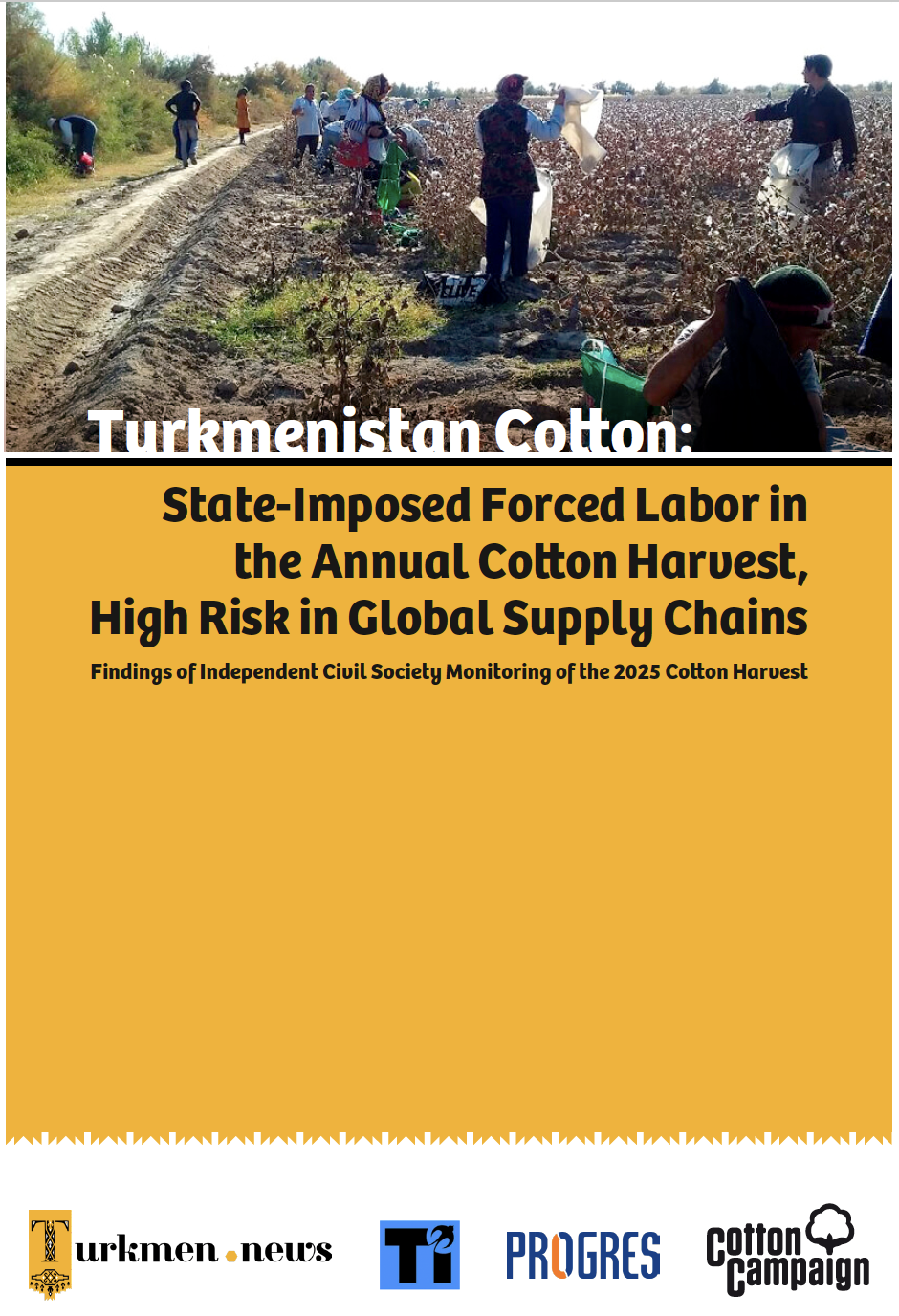
(Washington, DC, May 12, 2026) The Turkmen government should take urgent and significant steps to eliminate the use of state-imposed forced labor, empower workers and farmers, and allow independent reporting without fear of retaliation, the Cotton Campaign coalition said. The call follows today’s release of independent civil society monitoring findings of the 2025 cotton harvest in Turkmenistan by Cotton Campaign members Turkmen.News and Turkmen Initiative for Human Rights. The report, “Turkmenistan Cotton: State-Imposed Forced Labor in the Annual Cotton Harvest, High Risk in Global Supply Chains”, finds that the Turkmen government reversed the modest reduction in forced labor it had made in the previous harvest. Instead, the state reverted to widespread mobilization of public sector employees—including teachers, doctors, and workers at utility organizations—and conscripts to pick cotton or extorted them to pay for replacement cotton pickers. Cotton harvested with state-imposed forced labor in Turkmenistan enters global markets, primarily through textile manufacturers in Türkiye and Pakistan, but also through suppliers in Europe, including in Portugal and Italy, that use Turkmen cotton, yarn, or fabric in the production of goods.
"The use of widespread and systematic state-imposed forced labor has a downward spiral effect on Turkmen people, who are already facing a deep economic crisis,” said Ruslan Myatiev, director of Turkmen.News, an independent media and human rights organization, which also monitors forced labor in Turkmenistan’s cotton fields. “For example, mobilization of school teachers and kindergarten nannies to pick cotton created staff shortages and had a significant impact on the quality of education. Governments and international organizations, including the International Labour Organisation, should increase pressure on the Turkmen government to take concrete and meaningful steps to end this egregious practice.”
During the 2025 harvest, public authorities mobilized or extorted all categories of public sector employees without exception. Despite signing a consecutive Roadmap for Cooperation with the International Labour Organisation (ILO) to address forced labor in the harvest, in 2025 the government of Turkmenistan reversed preliminary measures it had taken in the previous year to begin reducing the number of doctors and teachers forced to pick cotton. The report also documents the use of child labor in the harvest, with children picking cotton alongside family members to help them meet the assigned quotas or being hired as (replacement) pickers.
“In Turkmenistan, forced labor is imposed and enforced by the state at all levels of government, making it impossible for brands to prevent or remediate forced labor on specific farms,” said Raluca Dumitrescu, Senior Coordinator of the Cotton Campaign Coalition, Global Labor Justice. “In jurisdictions where forced labor import ban mechanisms exist or will soon be created—including across the EU as the Forced Labor Regulation comes into full application—relevant government agencies should recognize Turkmen cotton as a commodity made with state-imposed forced labor and introduce a ban against all products made wholly or in part with Turkmen cotton. Forced labor import bans should be introduced where they don’t yet exist, which would help create a level playing field and ensure meaningful action to eliminate forced labor Turkmen cotton from global supply chains.” All cotton and cotton products originating in Turkmenistan have been barred from the US since 2018.
The report launched today also shows that coercion and exploitation of farmers continued in 2025. Corruption remains pervasive in the cotton sector and contributes to the impact of climate change on farmers. While Turkmenistan faces rising temperatures, water scarcity, and soil salinization, cotton farmers reported restricted access to irrigation water, including being required to pay bribes to local officials to get their fields irrigated. These practices impact the cotton yields and significantly increase the burden on farmers to meet state-imposed production quotas.
“The government of Turkmenistan should introduce reforms that increase farmers’ autonomy, as well as accountability and transparency of the agricultural sector,” said Aynabat Yaylymova, Director of Progres Foundation, a member of the Cotton Campaign coalition. “Farmers should be involved in policymaking— especially as it relates to the development and implementation of reliable and equitable access to irrigation water. The EU and Germany, as co-financers of the program “EU for a Green Turkmenistan” to support Turkmenistan in addressing climate change impacts, should require the Turkmen government to end its coercive control over farmers and allow them to assert agency in deciding the conditions under which they grow cotton and other crops.”
International stakeholders play a critical role in increasing pressure for reform. As Turkmenistan seeks to intensify engagement with the EU, as well as with the European Bank for Reconstruction and Development (EBRD), these institutions should condition loans and investment opportunities to the elimination of state-imposed forced labor in cotton production and the creation of an enabling environment for labor rights.
###
The Cotton Campaign is a coalition of human and labor rights NGOs, independent trade unions, brand and retail associations, responsible investor organizations, supply chain transparency groups, and academic partners, united to end forced labor and promote decent work in cotton supply chains in Central Asia.
Later edit: On May 27, 2026, the Cotton Campaign hosted a webinar to discuss the findings of the report.
Background information
Forced labor import bans
In the US, a Withhold Release Order (WRO) against Turkmen cotton has been in effect since 2018, banning imports of all products made in whole or in part with Turkmen cotton. Compliance with the Uyghur Forced Labor Prevention Act (UFLPA) is an opportunity for companies retailing in the US to eliminate Turkmen cotton from their supply chains. As they trace their supply chains to the raw material level and exclude all goods made in whole or in part with the use of forced labor of Uyghurs and other ethnic minorities in the Xinjiang Uyghur Autonomous Region (XUAR) to ensure compliance with the UFLPA, brands and retailers should also trace and eliminate Turkmen cotton from their products, at all stages of production.
The United States-Mexico-Canada Agreement (USMCA) prohibits forced labor products from entering the signatory countries. In 2020, Canada introduced legislation that bans imports of goods manufactured wholly or in part by forced labor. Similarly, in 2023, Mexico introduced regulation that prohibits the importation of goods produced wholly or in part with forced labor.
In November 2024, the EU adopted the EU Forced Labour Regulation, which bans the import, export and internal sale of goods made in whole or in part with forced labor. The Regulation will come into full application in December 2027. The Regulation directs competent authorities to prioritise investigations in consideration of the scale and severity of the alleged harm, including whether state-imposed forced labor could be a concern. The risk database, required by the Regulation, will include sectors and areas with evidence of state-imposed forced labor. The database of forced labor risks will serve as a key source of information for authorities and economic operators.
Various other jurisdictions are resolved to introduce similar laws. An overview is provided in the report launched today.
EU-Turkmenistan Engagement
According to the EU Commission website, “The EU has allocated €18 million to support its bilateral cooperation with Turkmenistan in 2021-2027. The country also benefits from all EU regional programmes.”
In particular, the EU and the German government are co-financing the program ““EU for a Green Turkmenistan: Policy Dialogue and Climate Action 2024–2028,” aiming to “to promote sustainable green development in Turkmenistan through the introduction of international best practices and EU standards.” Neither the website of the EU Delegation to Turkmenistan, nor the page of the Green Central Asia initiative, which is the umbrella project for “EU for a Green Turkmenistan”, mentions any requirement for the Turkmen government to respect and protect human and labor rights, or end coercion and exploitation of farmers, as part of a transition to a green economy.
The EU has funded activities to support Turkmenistan’s accession to the World Trade Organization (WTO).
In 2019, the European Parliament did not approve the ratification of an EU-Turkmenistan Partnership and Cooperation Agreement (PCA) proposed by the EU Council and the EU Commission because of strong concerns about human rights violations committed by the government of Turkmenistan. The Parliament adopted a resolution setting out concrete human rights benchmarks that it expects to see sustainable progress on by Turkmenistan before giving its consent to the PCA, including an end to forced labor. In 2024, in a resolution on the EU strategy on Central Asia, the European Parliament again stressed the need for Turkmenistan to demonstrate improvements in its dire democracy and human rights records in order for the Parliament to reconsider its position vis-a-vis the PCA.
